How to Safely Import a Car from China to Europe (2026)
Rozliczamy akcyzę zdalnie w całej Polsce. Rejestrujemy samochody w Warszawie. Działamy od 2008 r.
Zadzwoń do nas
Napisz do nas
kontakt@akcyzawarszawa.pl
Wyślij nam dokumenty auta – sprawdzimy, od czego zacząć. Akcyza Warszawa
O Firmie
Właściciel serwisu: Mariola Ślęczkowska
REGON: 141314025
NIP: 4960058650
Adres biura
Aleja krakowska 157 02-180 Warszawa
Short answer: a car from China pays 10% EU import duty at customs; battery-electric cars also pay an EU countervailing duty that depends on the manufacturer. In Poland you also pay excise duty (electric cars are exempt) and 23% VAT. A new car needs EU type approval or an individual approval before registration.
Pomoc z formalnościami
Zacznij od wiadomości
Need help? We handle customs clearance and excise for cars imported to Poland and register cars in Warsaw. WhatsApp +48 509 274 704 – we reply quickly, including evenings and weekends.
Od 2008 r. · ponad 2 000 spraw akcyzowych i ok. 1 000–1 200 rejestracji rocznie
💬 Napisz na WhatsApp📞 509 274 704✉️ kontakt@akcyzawarszawa.pl
Tempted by cheap new EVs from China but worried about paperwork or hidden fees?
You're not alone. Those attractive online prices rarely show the true, final cost. Let’s break down how to import a car from China to Europe in 2026 clearly, step by step—perfect for private buyers or small businesses.
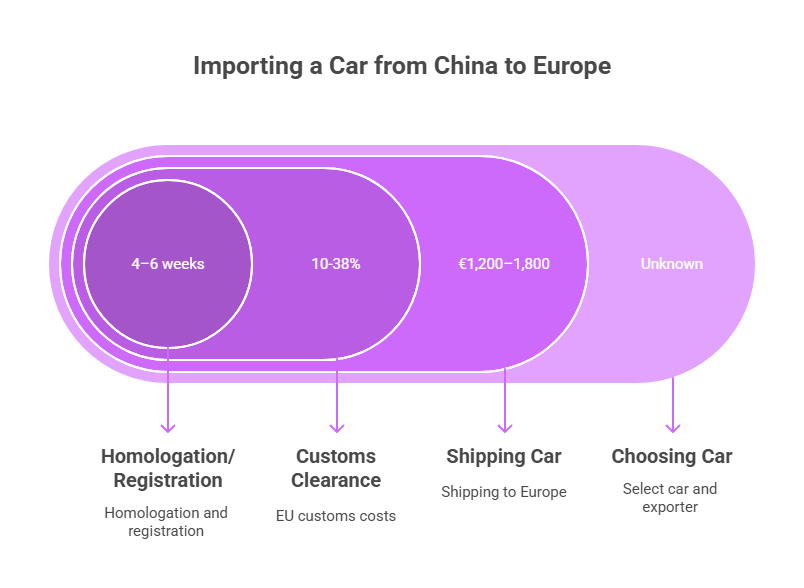
✅ Step 1: Choosing the Right Car and Exporter
-
Go with Known Brands: BYD, Geely (including Smart), MG, Leapmotor—these often already meet EU standards or provide easier documentation.
-
Avoid Risky Deals: Skip unfamiliar sellers from Alibaba or random exporters; scams are common.
-
Secure the Deal: Ensure your contract clearly lists vehicle details (model, VIN, specs), shipping terms (CIF), and payment terms.
Pro tip: Always pay through a secure method like escrow or letter of credit.
🚢 Step 2: Shipping Your Car to Europe
Three main options:
-
Ro-Ro (Roll-on/Roll-off): Cheapest and quickest, weekly sailings.
-
Shared Container: Safer but slower and slightly more expensive due to extra handling.
-
Exclusive Container: Safest and best protection for premium vehicles.
Ask the freight forwarder for a quote that includes insurance and port fees, and for the expected transit time.
📄 Step 3: Essential Documents to Prepare
Before your vehicle arrives, have these documents ready:
-
Purchase Invoice and Contract
-
Bill of Lading (from shipper)
-
Chinese Export Certificate
-
Technical Specifications
-
EU Certificate of Conformity (CoC) or Homologation Certificate
-
Warranty Documentation (translated)
Critical Note: Many Chinese vehicles don't have an EU CoC, requiring extra homologation steps later.
💶 Step 4: Customs Clearance, Duties, and Taxes
EU Customs Costs:
-
Import Duty: 10%, plus an EU countervailing duty of 7.8–35.3% on Chinese battery-electric cars, depending on the manufacturer.
-
VAT: Typically around 19–23% (e.g., Poland is 23%) calculated on vehicle price plus import duty and shipping.
-
Excise (Poland specific):
-
EVs: 0%.
-
Standard combustion cars: usually 3.1% for engines up to 2000cc.
-
-
Other Fees: Customs handling, temporary plates, if you need them.
Example: importing a new battery-electric BYD to Poland, value €30,000 including shipping to the EU port (CIF):
-
Import duty (10%): €3,000; countervailing duty (17.0% for BYD): €5,100
-
VAT (23%): €8,763 (on €38,100: value + duty + countervailing duty)
-
Excise: €0 (EV)
- Customs agent and port fees: extra. Total Cost Approx.: €46,863 plus fees
🚀 Smart Shortcut:
Want to avoid hassle, missed paperwork, or surprise fees? akcyzawarszawa.pl can help with the Polish part. They handle excise tax and vehicle registration in Warsaw and organise sworn translations.
🛠 Step 5: Homologation and Registration
- Technical inspection and approval: the technical inspection is done at a vehicle inspection station (SKP); a car without an EU CoC also needs an individual approval issued by the Polish approval authority (Director of TDT). Typical checks: lights, seat belts, km/h speedometer, emissions.
-
Homologation Testing: If no EU CoC, testing at a designated technical service is needed; ask it for a quote.
-
Vehicle Modifications: Might include EU-spec lights, speedometer adjustments, and software updates.
-
EU License Plates: After passing inspections, you’ll receive permanent plates.
-
Vehicle Registration: Final step at your local vehicle registration office with ID, customs papers, and inspection certificates.
Allow several weeks, and more if an individual approval is needed.
⚠️ Common Pitfalls & Mistakes
-
Missing CoC or incomplete homologation paperwork: Delays or failed registration.
-
Incorrect customs valuation: Risk audits and fines.
-
Technical certification errors: Inspection failures and further delays.
-
Insurance Issues: May initially face refusal without proper documentation.
-
Service and Parts: Ensure availability; unknown brands often lack local support.
📋 Import Checklist for Smooth Process
| Step | Items to Prepare |
|---|---|
| 1. Purchase | Secure contract, payment protection, detailed specs |
| 2. Documentation | Export certificate, technical specs, EU CoC |
| 3. Shipping | Choose shipping type, insurance, ETA |
| 4. EU Arrival | Customs declarations, duties/VAT, temporary plates |
| 5. Homologation | Technical tests, modifications, EU certification |
| 6. Registration | Local paperwork, permanent plates, insurance |
Commonly forgotten: undercarriage bio-cleaning, speedometer conversion, proper excise tax filings, certified translations.
❓ Real Questions from Importers
-
Do all Chinese cars have EU homologation? No. Cars built for the Chinese market usually lack it, while versions sold in the EU have it.
-
Can private persons import cars? Yes, fully possible but requires self-management of all customs and inspections.
- What's the total final cost? CIF price + roughly 35–80% in duty, countervailing duty, excise and VAT (depending on the drive and the manufacturer), plus inspections and fees.
-
Is importing cheaper than buying locally in Europe? Possibly yes, but tariffs and testing might reduce savings.
-
Warranty coverage? Usually limited or China-only; confirm EU options before buying.
-
How long is the total process? It depends on shipping and on whether an individual approval is needed, so plan for months rather than weeks.
-
Resale difficulties? Document everything thoroughly to ensure easier resale, though resale value for lesser-known brands can be unpredictable.
🧠 Final Advice
-
Stick to reputable exporters and known brands.
-
Plan homologation early to avoid costly delays.
-
Consider professional help with customs clearance, excise and registration in Poland (like akcyzawarszawa.pl).
Zobacz też: Import Car from USA to Poland
Sources (as of 5 November 2026): Polish Excise Duty Act – Art. 104–106, 109a, 163a; Polish Road Traffic Act – Art. 81; Polish VAT Act – Art. 30b.
Potrzebujesz więcej wiedzy?