How to Get Polish License Plates: Easy Car Registration Guide [2026 Rules]
Rozliczamy akcyzę zdalnie w całej Polsce. Rejestrujemy samochody w Warszawie. Działamy od 2008 r.
Zadzwoń do nas
Napisz do nas
kontakt@akcyzawarszawa.pl
Wyślij nam dokumenty auta – sprawdzimy, od czego zacząć. Akcyza Warszawa
O Firmie
Właściciel serwisu: Mariola Ślęczkowska
REGON: 141314025
NIP: 4960058650
Adres biura
Aleja krakowska 157 02-180 Warszawa
Short answer: to get Polish plates, apply for registration at the vehicle registration office (wydział komunikacji) of the district where you live, within 30 days of buying the car or bringing it to Poland (art. 73aa PoRD). You need proof of ownership, the previous registration certificate, a valid roadworthiness test, your ID and – for a car from another EU country – proof that Polish excise duty was paid. Registration with new plates costs 160 PLN; missing the deadline means a 500 PLN fine (1,000 PLN after 180 days).
Foreigner in Warsaw? You also need a registered address (zameldowanie) and a residence document – see car registration in Warsaw for foreigners.
Need help with a car from abroad? We settle Polish excise duty remotely for clients anywhere in Poland (250 PLN) and register cars in Warsaw on your behalf (350 PLN; official fees are paid separately) – car registration service in Warsaw. WhatsApp 509 274 704 – we reply right away (Mon–Fri 7:00–15:00).
Polish authorities can fine you up to 3,000 PLN if you drive without proper license plates. Missing a simple registration deadline comes with a steep penalty.
Your vehicle needs proper registration whether you import it or buy it locally. This piece walks you through each step to obtain your Polish license plate. We cover everything from document requirements to solutions for common registration challenges. Our goal is to help you get those plates correctly and keep your money away from unnecessary fines.
Contents · approx. 8 min read
Understanding Polish License Plate System
Polish license plates use a clear format that makes identifying vehicles easy. The current system came into effect in 2000. It combines letters and numbers to show details about where and how the vehicle was registered.
Types of Polish License Plates
Regular Polish plates show black text on white backgrounds. They have two main parts with a space between them. The first part has two or three letters showing the area's jurisdiction. The second part contains four to five characters. A legalisation sticker sits between these sections.
What Numbers and Letters Mean
The first letter shows which of Poland's 16 voivodeships the vehicle belongs to. One or two more letters point to the specific district or city. To name just one example, "WA" means Warsaw, "KR" stands for Kraków, and "PO" represents Poznań.
The system leaves out certain letters to avoid mix-ups:
- Q doesn't appear since it's not used in Polish
- The series area skips B, D, I, O, and Z to prevent confusion with numbers
Some voivodeships have a second letter, used only after numbers with the first letter run out (§ 31 ust. 3 and annex 13 of the regulation Dz.U. 2024 poz. 1709): D and V (Lower Silesia), K and J (Lesser Poland), W and A (Masovia), R and Y (Subcarpathia), G and X (Pomerania), S and I (Silesia), P and M (Greater Poland).
Special Plate Categories
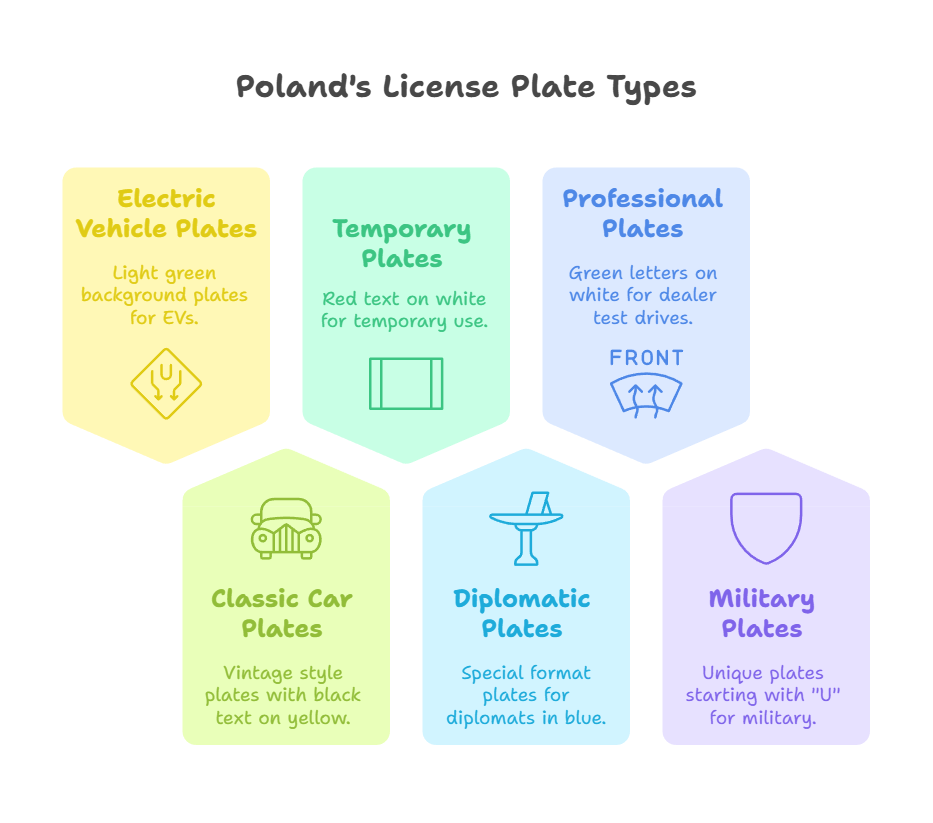
Poland's license plate system has several unique types:
-
Electric Vehicle Plates: These come with light green backgrounds instead of white since January 2020
-
Classic Car Plates: Black text appears on yellow backgrounds alongside a vintage car image
-
Temporary Plates: Red text shows up on white backgrounds with seals showing month and year
-
Diplomatic Plates: White text stands out on blue backgrounds, using a special format that starts with "W" for Warsaw
-
Professional Plates: These arrived in July 2019 with green letters on white backgrounds, mainly for dealer test drives
-
Military Plates: These start with "U" rather than the usual voivodeship code
Custom plates let owners add personal touches within certain rules. Each plate must begin with a voivodeship letter and a number. Owners can then choose up to five characters. A custom plate costs 1000 PLN, which is much more than regular registration fees.
Required Documents for Registration
Getting polish license plates starts with the right documentation. The registration process needs careful preparation of paperwork, especially when you have missing documents that can slow things down.
Basic Document Checklist
The simple documents you need to register your vehicle include:
Proof of Vehicle Ownership, which can be showed through:
- VAT invoice confirming purchase
- Sale agreement
- Exchange agreement
- Donation agreement
- Final court decision ruling on ownership
-
Technical Documentation:
- Valid technical inspection certificate – not needed if a valid test is recorded in the central vehicle register or confirmed by a document from an EU/EEA country or Switzerland (art. 72 ust. 1 pkt 4 and ust. 2 pkt 9 PoRD)
- Vehicle registration certificate
- Vehicle card (karta pojazdu) – no longer issued since 2022, so it is not required for a car registered in Poland after that date
- EC certificate of conformity – only for the first registration of a new vehicle (§ 2 ust. 5 of the regulation Dz.U. 2024 poz. 1709)
-
Essential Paperwork:
- Completed registration application
- Third-party liability (OC) insurance – not attached to the application, but it must be in force no later than on the registration day
- Original license plates (if applicable)
- Payment confirmation for registration fees
Additional Papers for Foreigners
Foreign residents need extra documentation beyond the simple requirements:
Primary Documents:
- Valid passport as proof of identity
- Temporary or permanent residence documentation
- Relevant visa or residence permit
Additional Requirements:
- A sworn translator or competent consul must translate foreign language documents to Polish – except registration certificates issued in an EU/EEA country or Switzerland and EC certificates of conformity (§ 5 ust. 2 of the regulation Dz.U. 2024 poz. 1709)
- Current copy of National Court Register (KRS) for legal entities
- International agreements or embassy certificates for cultural centers
- Accreditation papers for press correspondents
Vehicles imported from non-EU countries need import clearance documentation. On top of that, certain vehicle types from EU member states need proof of excise duty payment or exemption certification.
If someone else registers the car for you, they need your written power of attorney – no notary is required – and you pay 17 PLN stamp duty for it. Submit the original power of attorney, or a copy certified by a notary or by a lawyer acting as your proxy.
Note that you must apply for registration within 30 days of vehicle purchase. Missing it costs 500 PLN, or 1,000 PLN if you are more than 180 days late. Your documents should stay valid throughout the registration process to avoid complications or delays.
Step-by-Step Registration Process
You must apply for registration in Poland within 30 days after purchase. Business owners who trade vehicles get 90 days to complete this process.
Online Pre-registration Steps
You can usually book a visit online. To file electronically you need a trusted profile (ePUAP) and clear scans of your documents, but your local office may still ask for originals, so check its digital services first.
Visit to Communication Department
The Communication Department (Wydział Komunikacji) in your district handles vehicle registrations. Some offices allow only one vehicle per appointment, so check when you book. Bring your completed application and original documents to your appointment. Your permanent or temporary address (or your company's registered office) determines which office will process your application (art. 73 ust. 1 PoRD).
Payment and Collection
You can pay registration fees through these methods:
- Bank transfer (you must include vehicle make, model, and VIN number)
- District office cash desk
- Fee machine (if your office has one)

Registration costs 160 PLN. If you keep the existing Polish plates, you pay only 54 PLN (67.50 PLN with a temporary permit).
Temporary Permit Usage
The registration process gives you:
- A 30-day temporary registration permit
- Your licence plates (red-on-white temporary plates are issued only for temporary registration on request, e.g. for export)
- A temporary vehicle registration decision
Update your vehicle's insurance policy right after you get your registration decision. The office can extend your temporary permit once for 14 more days if needed.
The registration certificate is produced by the Polish Security Printing Works (PWPW). Collect it, and the final decision, before your temporary permit ends. New vehicle dealers can handle registrations for cars bought after June 2021. Used car buyers must complete the process themselves or send an authorized representative.
Common Registration Problems
Getting polish license plates can be challenging. You can make the process easier by knowing what problems to expect.
Missing Document Solutions
Lost or damaged registration documents create the biggest problems. You should ask for a duplicate from the authority where your vehicle was last registered. The starosta can also directly confirm the needed data with foreign registration authorities. Paper or electronic verification can replace any missing documents once confirmed.
Businesses that import vehicles have other documentation choices. Traders can replace import clearance papers with an ownership proof endorsement that has:
- Authority name
- Document number
- Clearance date
Translation Requirements
You need certified Polish translations for foreign language documents, except for:
- EC certificates of conformity and registration certificates from the EU, EEA or Switzerland (§ 5 sec. 2 of the regulation; the office may ask about national entries if in doubt)
These documents need authentication from a sworn translator or competent consul:
- Registration certificates from non-EU countries (EU/EEA and Swiss certificates need no translation)
- Purchase agreements
- Technical documentation
A contract that already has a Polish version can save translation costs, but the registration office decides whether to accept it. Otherwise it needs a sworn translation (§ 5 sec. 1 of the regulation).
Insurance Issues
OC insurance must be in force no later than on the registration day. You do not attach the policy, because the office can check it in the register run by the Insurance Guarantee Fund (UFG). Driving without OC means a fine from UFG.
Remember these key insurance points:
- Update third-party liability certificates after buying a vehicle
- Tell current insurers about vehicle ownership changes
- Get new coverage before your old policy expires
Sellers must tell their insurer about the sale, and buyers need to update insurance policies. Buyers can end existing insurance agreements through written notification, preferably sent by registered mail.
Conclusion
Polish vehicle registration rules keep you legal and help you avoid getting hit with pricey penalties. The system might seem complex at first, but breaking it down makes it easier to handle.
Regular registration will cost you 160 PLN. You can save money by keeping the existing plates, which brings the fee down to 54 PLN (67.50 PLN with a temporary permit). Your registration application must be filed within 30 days after purchase, or you risk a 500 PLN fine (1,000 PLN after 180 days). Different plate types make it easy to identify vehicles on Polish roads, from classic cars to diplomatic vehicles.
Getting your documents ready is the most important part. The process moves much faster when you have all required papers prepared, especially certified translations of foreign documents. People who need help can turn to akcyzawarszawa.pl, which settles excise duty remotely for clients anywhere in Poland and handles the complete registration process in Warsaw.
A careful approach to these steps will get your vehicle properly documented for Polish roads.
FAQs
Q1. How are Polish license plates structured? Polish license plates consist of two sections: the first contains two or three letters indicating the region, while the second has four to five characters. The initial letter represents one of Poland's 16 provinces, followed by letters identifying the specific district or urban area.
Q2. Can foreigners register a car in Poland? Yes, foreigners can register a car in Poland. They need to provide additional documentation, including a valid passport, temporary or permanent residence documentation, and relevant visa or residence permit. Foreign language documents must be accompanied by certified Polish translations, except EU/EEA and Swiss registration certificates and EC certificates of conformity.
Q3. What is the cost of registering a car in Poland? The standard registration cost for a car in Poland is 160 PLN. If you keep the existing Polish plates, you pay 54 PLN (67.50 PLN with a temporary permit). Imported cars pay the same fees as cars bought in Poland – there is no separate import fee.
Q4. How long do I have to register my vehicle after purchase in Poland? You must apply for registration within 30 days of purchase in Poland. Failing to do so means a 500 PLN fine, or 1,000 PLN after 180 days. For entrepreneurs conducting vehicle trading business, the registration period is extended to 90 days.
Q5. What documents are required for vehicle registration in Poland? The basic documents required include proof of vehicle ownership (such as a purchase invoice or sale agreement), technical documentation (including a valid technical inspection certificate and vehicle registration certificate), a completed registration application and payment confirmation for registration fees. OC insurance must be in force no later than on the registration day, but you do not attach the policy.
Zobacz też: Immatricolazione auto in Polonia · Professional Test Plates in Poland for Automotive R&D · Auto con targa polacca a Napoli
Sources (as of 5 November 2026): Prawo o ruchu drogowym (Road Traffic Act) – art. 72–74, 73aa, 140mb; regulation Dz.U. 2024 poz. 1709 – § 2, 5, 31, annex 13; Act on compulsory insurance – art. 29, 31–32, 88; Petty Offences Code – art. 94, 97; Stamp Duty Act – annex, part IV.
Potrzebujesz więcej wiedzy?